Category: 2022 Exhibition

Wesley John Fourie, Taarn Scott & Hana Pera Aoake : The future of dirt

Wesley John Fourie, Taarn Scott & Hana Pera Aoake
THE FUTURE OF DIRT
1st June – 25th June 2022

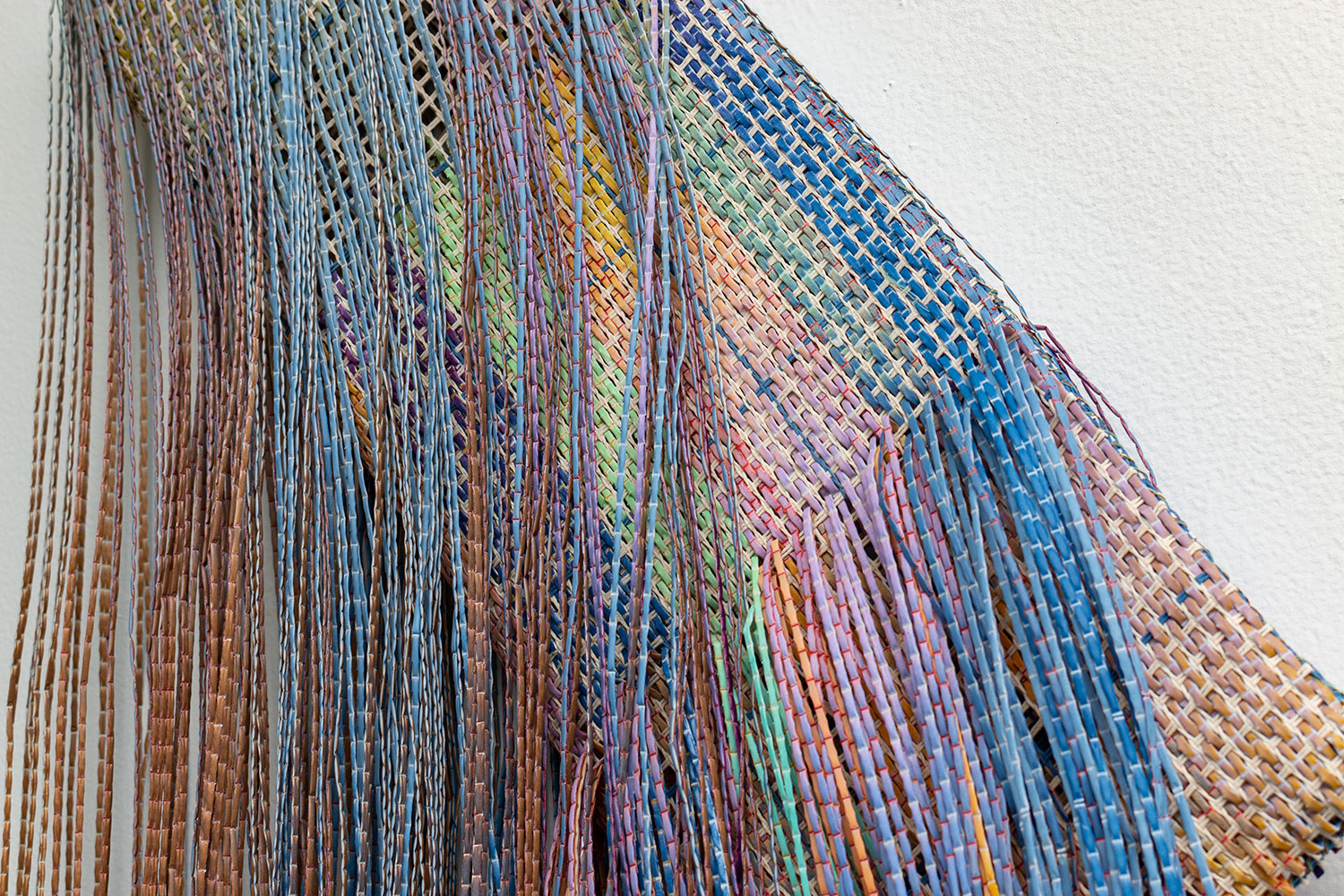
Through utilising the depositories of knowledge inherent in the whenua we are interested in how through art making we might explore our relationship to place, belonging and the historical and geographical tensions that exist within our bodies. These tensions are made manifest by thinking through the relation between being tangata tiriti and tangata whenua, and how through the physical and material embodiment of the places we live, we might find ways of coming together and understanding ways of upholding kaitiakitanga together. Given the whakapapa of uku (clay) it is important to us to think through its impermanence when unfired and acknowledge that it is everywhere, providing the building blocks of many life forms. By firing clay, utilising earth pigments for paint or simply presenting it as is or as dried powder, Hana, Taarn and Wesley look to explore some of all that it is.

Jade Townsend, Emiko Sheehan, Kei te pai press, Motoko Kikkawa, Sean Miles, The Angela Morton Room, Aroha Novak, Zoe Black, Lisa Meto Fox, Jimmy Ma’ia’i : After us, everything

Jade Townsend, Emiko Sheehan, Kei te pai press, Motoko Kikkawa, Sean Miles, The Angela Morton Room, Aroha Novak, Zoe Black, Lisa Meto Fox, Jimmy Ma’ia’i
Special words by Talia Marshall and Keri Hulme
AFTER US, EVERYTHING
1st June – 25th June 2022

After us, everything takes it’s name from the poem PAPATŪĀNUKU E TU! by the late Kai Tahu poet, Keri Hulme. This is a show or rather a conversation between friends about water, whenua and ways to share and the responsibility of leaving this world a little better than when we came.

Poster designed by Priscilla Rose Howe

brunelle dias, Llenyd Price & Gitanjali Bhatt : Local migrant

brunelle dias, Llenyd Price & Gitanjali Bhatt
LOCAL MIGRANT
5th May – 21st May 2022

This exhibition explores the Tauiwi/migrant encounters of the artists operating within their everyday ecology, and shares their acquisitions in tandem, inviting viewers to also spectate their relationship with their environments.

Alan Thomas : a set of impositions

Alan Thomas
A SET OF IMPOSITIONS
23rd March – 16th April 2022

Seeking freedom from anchoring assumptions, attribution and closure in the world, my indeterminate self is seduced by the provisional nature of stuff. My practice operates from a speculative standpoint inviting engagement in uncertainty. It questions its identity and seeks to deny itself, to deny a tangible reality.
 
This provisionality is perhaps most strongly rendered through recent empirical understandings in neurobiology, evolutionary theory and physics. Evolution, it seems, ensures that whatever it is we believe we are perceiving bears no relationship to the truth of matter1. And our perception is predominantly projective—we experience what we expect to experience, we impose affirmation on the world2.

To interrogate ways in which material and matter can be understood, I seek states of transition and thresholds of uncertainty. Through extended observation of material interaction and behaviour, I capture metamorphic junctures. Here, instants when materials interact in unforeseen ways are caught, frozen in the act. Changes of state and energy are buried within ceramic and metallurgic processes. Integrating the associative histories of these materials into my practice, both material present and material absent determine what becomes apparent. There is perhaps a vulnerability in these transformative moments that belies the material. 

I aim to draw into the nexus of human expectation and human limitation that obscures unimaginable complexity, the convolution within. Using sculpture as allusion without compass, as an operative language, an apparent state of entity, I seek to explore the provisionality of matter. Through this, I speculate, material indeterminacy might be glimpsed, free of anchoring assumptions, offering fresh reconciliation with the perceived world.

1] Hoffman, Donald (2019) The Case Against Reality: How Evolution Hid the Truth From Our Eyes. Allen Lane/Penguin Random House, London. Hoffman shows, using evidence from evolutionary theory, game theory and neuroscience, that evolution has shaped human senses to keep us alive, but to hide any truth from us.
2] Seth, Anil K (2021) Being You. Faber & Faber, London. Seth’s account of consciousness as a predominantly predictive engagement with the world explores fundamental questions about the self from philosophical and neuroscientific perspectives. 

Daniel Strang : Openings

Daniel Strang
OPENINGS
16th February – 12th March 2022

Often exhibition openings are used in films as a narrative device to create a sense of climax, they frequently involve some kind of conflict or displacement, in which a character finds themselves lost within a strange cult-like world. Jostling and joking, people eat, drink and vie for attention. The art world, its inhabitants and its rituals are portrayed as dynamic, chaotic and extraordinary. As the video Openings demonstrates, in the history of film, exhibition openings are useful devices for portraying characters who, Icarus-like, are reaching new heights of fame and pretension as well as bewildered outsiders who gawp at the strange milieu. In the context of binge-watching, on-line mega cuts and mash-ups, Openings is an obsessive and meticulous compilation, an expression of archival cinephilia. It uses innovative methods of editing-as-making to combine banality with high drama, breaking open existing narratives, opening them up and re-arranging them into new and surprising formulations. The work is particularly relevant at a time when the babble and crush of coming together, sans mask, in large numbers to fete an artist and their newest work is starting to seem like a distant memory.

Daniel Strang is an artist, film editor and cameraman based in Tāmaki Makaurau Auckland. Since graduating with a Masters in MediArts in Moving Image from Wintec, Hamilton in 2008 he has been working in photography, film and video. Recent exhibitions include: Event Horizon, curated by Jamie Hinton (Ilam Campus Gallery, Christchurch, 2016), Roadkill Cat Rug (Window, Auckland, 2015); HOSANNA! (Saint Kevins Arcade, Auckland 2012) and may I admire you? (1/155 Symonds Street, Auckland, 2010.)

Strang frequently assists artists with video production including: Tim Wagg, Jim Allen, Mark Harvey and Sarah Smuts Kennedy. He also collaborates with artists and galleries to create performance documentation and has done so in the past at: Artspace Aotearoa, Te Tuhi Centre for the Arts and Te Uru Waitakere Contemporary Gallery.

Ana Carmela Garcia : Temporal Encounters

Ana Carmela Garcia
TEMPORAL ENCOUNTERS
16th February – 12th March 2022

“In the archive there is a specific temporal dilemma: it is the idea of beginning in the past, in the present, with a voice that is now.”

Jo Melvin, “Notes on inscription: tangential and awry archive stories” in The Archive, 
The Event and its Architecture, ed. Lucy Gunning, The Wordsworth Trust, 2007, 47-48

We must ask ourselves, where does one’s life end and a practice begin? And should it?

Through an archival process, the mundane and ordinary objects and instances from a migrant’s life are collected and sorted, allowing pause and space for new meaning to shine through. In collaboration with RM’s rich archive of previous shows alongside Ana Garcia’s own migrant archive, the audience is invited to reencounter the past, question, ask and learn. With eyes of the present and feet toward the future, we can once again enter the moments that pass swiftly, renewing their significance for ourselves today. 

Being equally an artist and a migrant, Ana’s life experiences from birth to present, feed into the lifeblood and core of her practice. They form both her life as she knows it today and the license to then critique its social contexts. In recent years, many have come to realize the importance of moments of pause and reflection in our lives. This is where we re-encounter ourselves, where we can see in a new light, the significance of our daily actions, where we sit within the frameworks of our society and our place in the world.

Dieneke Jansen : You’re welcome

Dieneke Jansen Youre Welcome Announcement

RM lives in a neighbourhood with several spaces that house and host art alongside dwellers including luxury apartments owners, loft livers wrestling late capitalism and public housing tenants. A concern for the gentrification of this place that clusters around Karangahape Road has been voiced for years, perhaps decades. This means different things to different people – inevitably underpinned by the fear that increasing real-estate value will by default result in expulsions.[1] In some cities, artists are cynically used to gentrify urban areas. Yet it seems that there is some passion for this part of Tāmaki Makaurau to continue to house a range of residents and artists. At least, I hope so.

Belonging to an ongoing trajectory, You’re Welcome collaboratively develops dwelling narratives with inner-city housing residents and art community through exploring the possibility for a lens-based social practice to co-create spaces of appearance.[2] I’m interested in the connections across these spaces and utilising the forms and platforms of art to open front and back doors. You’re Welcome starts this trajectory by encouraging stories to surface about home and the neighbourhood.

Under these precarious pandemic conditions, You’re Welcome had to wait and then adapt. Meeting with friends and acquaintances – several without internet access – shifted the project’s methods while maintaining its desire to use photographs as conversation starters. When it was safe to meet in nearby parks during October and November, eight disposable cameras were handed out to nearby public housing tenants. Each person photographed things ‘that make it your home’ and things ‘that makes it your neighbourhood’. On picking up the camera, we undertook a video walk. On returning the photographs, each person edited out anything they didn’t want to share publicly and selected two photographs for the online exhibition that accompanied their video walk. This forms the first part of the project hosted online by RM. In the third week of February (17-19th), the second part of this project will occur at the Old Folks Association. A video chatroom will be set up that will be hosted by different project collaborators each day.[3] Playing cards made from the generated photographs will be used in various ways to start conversations and share experiences and outlooks. In sharing and rotating the roles and responsibilities of the chatroom events, it explores how a lens to be a respectful guest and a caring host in shared hands.

I want to express the joy I have experienced in regularly meeting with Gina, Edward, Six, Frances, Vernon, Tim, Francine and Teare whose friendship and trust I care for.

[1] David Harvey, ‘The Right to the City’, in Rebel Cities: From the Right to the City to the Urban Revolution (Verso, 2012); Saskia Sassen, Expulsions: Brutality and Complexity in the Global Economy (Cambridge, Massachusetts: The Belknap Press of Harvard University Press, 2014).

[2] Hannah Arendt, The Human Condition (Chicago: The University of Chicago Press, 1958).

[3] I would like to acknowledge Tuafale Tanoa’i, AKA Linda T, for her inspiring art practice as these events take place.

Teare


Edward


Tim


Vernon


Francess


Frances


Gina


Six

Lucy Meyle and Ziggy Lever : SNAIL TIME II

Lucy Meyle and Ziggy Lever
SNAIL TIME II
13 January – 5th February 2022

Curving over hard and hidden-into, the whorled structure of a snail’s shell suggests an infinite deepening of time as it turns inwards again and again in a vertigo spiral. In our writing and research about the snail, we came to think about how texts and images can become tied to one another across time, and how these ties create slippery trails between ideas. This installation proposes to meet the snail in a field of open query, where ideas and thoughts connect indirectly via shimmering trails of meaning that spiral in and out of the installation.

Fresco (c.1343-1344) depicting a vivarium. Located in the Chambre du Cerf at the Palais des Papes, Avignon, France.

William Linscott : What happens next will warm your heart

William Linscott
What happens next will warm your heart
27 January – 5 February 2022
View roomsheet

Platform companies are centralising. The vast power that they hold concentrates and consolidates. As platforms and states mix, new sovereign forms begin to emerge. The border of the cloud and the loop of the land blend, blur, and become confused. The closed worlds of walled gardens now built at planetary scale.

Network effects drive ever more traffic through the proprietary infrastructures of platforms. These private businesses are able to instrumentalise information in novel ways utilising established logics of extraction, accumulation, expropriation, and exploitation. The forces of production and class relations however, are further abstracted, and as a result, harder to challenge and oppose.1

Not only do platforms own and control network infrastructures as intermediaries, but they design and manage their flows, automating social relations as they go. Their governing logics increasingly come to define what is and isn’t probable, what is and isn’t plausible, and what is and isn’t possible.

The hegenomic forces of this oligopoly actively depoliticise and abstract private platform actors and imperatives. Certain illusions and myths must be maintained to serve as justifications for the present. Platform companies need to legitimise and reinforce themselves in order to reproduce themselves; and in doing so they simultaneously preclude and foreclose radical and emancipatory alternatives.

A certain mono-technological culture prevails. It relies on a universal model of technology and determinist understandings of its transformative force within the ‘progress’ of history.2 The world is reproduced in its image and images are reproduced in its world. Its realities are being made through algorithms. Not only do they reinscribe preexisting knowledge (ignorance, bias, and all) but they generate and form it.

At the level of the user these algorithmic regimes appear to us regularly through interfaces. We usually see straight past them and their processes of mediation. Even if we were to try to grasp them, we can only catch a glimpse.

As users, their cognitive maps become ours: parameters are set, affordances determined, and users’ experiences delimited by particular organisational arrangements. These regimes are ideological in how they sublimate the world. Smaller gestures that on first sight may appear benign, are routinised and
amplified to an imperturbable universal. As platforms centralise they too homogenise, tending towards a singular form, a singular voice, a singular platform politico-aesthetics.

1The workers that maintain and hold up this infrastructure are often dehumanised and made hyper-precarious, amongst various processes of necropolitical desubjectificification. They are left invisible and forgotten. From subcontracted YouTube content moderators to Amazon’s Mechanical Turk microtaskers, employee-residents of Foxconn, the child labourers who mine cobalt, coltan, and other ‘conflict minerals’ in the DRC; the list goes on, further and deeper than is known. On the other hand, those who have assumed and accumulated vectoralist power can all too easily abdicate their very influence in order to eschew responsibility for their wrongdoings. This presents a moral hazard: those making the decisions are removed from their worst effects.

2We cannot continue along such determinist lines. Both technophiliac and technophobic tendencies are reductive and myopic. To approach emergent technologies more critically, we need to do so without blanket despair or naive optimism. Instead, should we follow in a Marxist tradition for example, one could attempt to understand technologies in relation to other organisational forms and through their interdependence and contingency with various institutional and administrative arrangements, production and labour processes, relations to nature, reproduction of daily life and of the species, as well as mental conceptions of the world.

RM Gallery and Project Space
Hours
Thursday and Friday 1pm - 5pm
Saturday 12pm - 4pm

Samoa House Lane
Auckland Central 1010

We are located in the centre of Auckland, off of Karangahape Road, on Samoa House Lane, just off of Beresford Street -- look out for the incredible fale of Samoa House and you're nearly there. We are 2 minutes walk from Artspace and Michael Lett.

The RM Archive Project

Help us identify what is in our Archive! We have digitised many slides in our archive and invite participation to identify them. Please click here to access the collection.
https://www.rm.org.nz/thearchiverm

Our Boxed Archive
Since 2009 RM has been building an archive of material related to our exhibition and event programme. An index to the collection is available here.
https://www.rm.org.nz/thearchiverm/artist-boxes-index/

Safe Space Alliance

RM is a member of Safe Space Alliance

A safe space is a space where the LGBTQI+ community can freely express themselves without fear. It is a space that does not tolerate violence, bullying, or hate speech towards the LGBTQI+ community.

A safe space does not guarantee 100% safety, rather, it’s a space that has your back if an incident (violence, bullying, or hate speech) were to occur.

Click here to find out more about Safe Space Alliance

Subscribe to the RM mailing list